
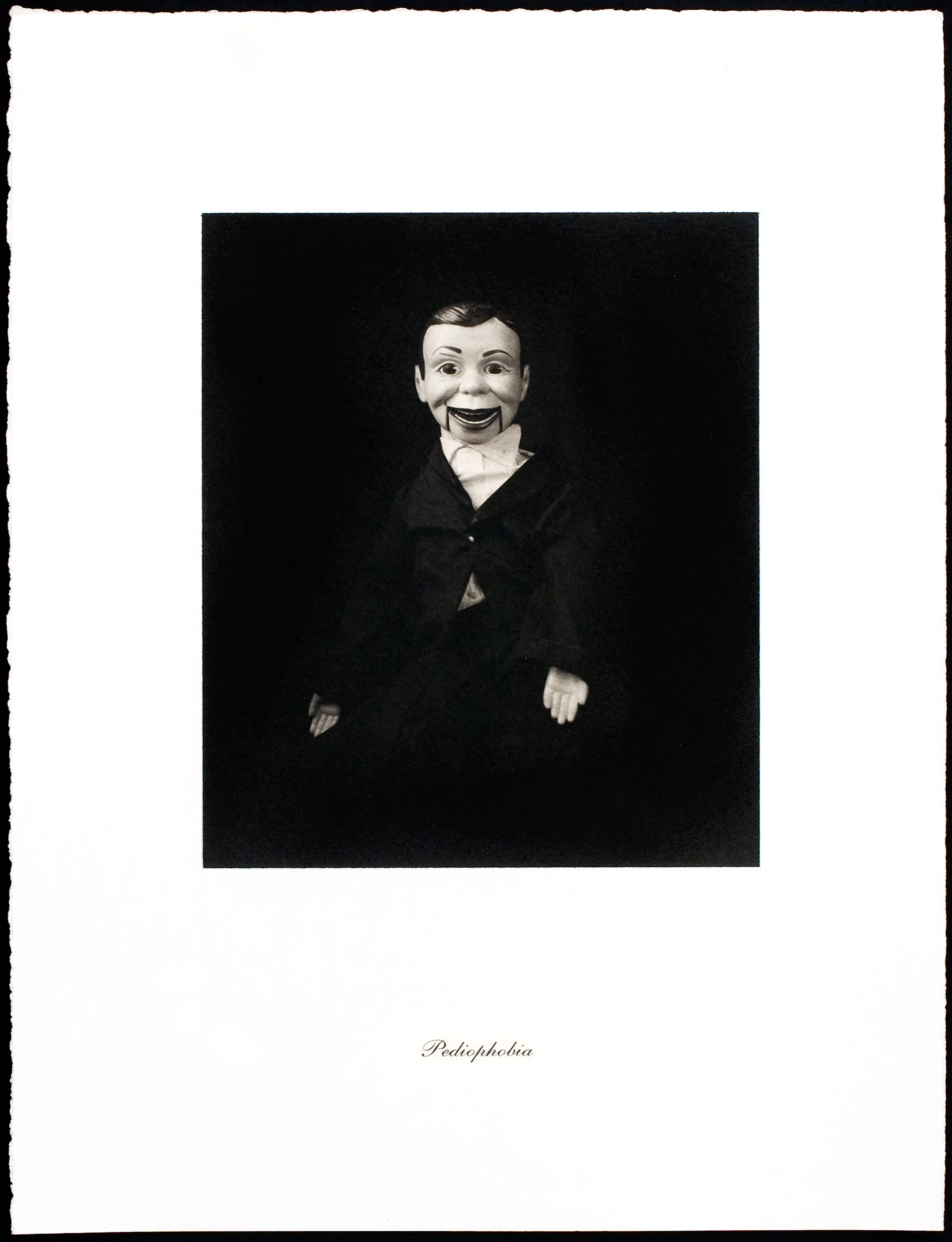
Susan Seubert © 2026
by Hugo Dos Santos
Separation agreement (continued)
On the wall to your right is a poster of the original cover of Gatsby, those optometrist’s eyes watching everything. Daisy warned you that large parties are more intimate and now this small call with just you and the two of them, your boss and the HR rep. Waiting for the longest day of the year, you might have missed it if not for the solemn invite to a late-June connection. What a waste—a meeting that could have been an email. You watched movies where this happened to people. Sounds leave their mouths but the lawyers trained them not to say anything, and so they read from a script because they must read from a script and in that, too, there is no humanity for you. You’re just another tool they no longer have a use for. It’s much easier remotely, with you calling in from the small office in your basement though you’re also not there and are rather some place where grander miracles are happening to you. In nature, nothing is gained, nothing is lost—everything transforms. And so you must transform now from this revoked definition of yourself to a precious organism in transition so that what follows might be more than what was. Others have done the same before: the long-ago poets fleeing conventions only to establish their own, your grandfather from political suspect to victim of the establishment, your own small eyes to orphans. Come to think of it, men in your line are always managing the trauma of a revoked identity. What, then, is this reduction in force if not just another example that genetics is a compelling driver, a gravity like a dream where you go along unable to remember the rules of the physical world? Your grandfather, was he even a revolutionary, in thought if not deed? Does it matter? And your father, did he trade one dark fate for another of similar fabric? And you, fitting yourself now for your own kind of detached darkness, the one you reach for when you don’t know where else to go—I know it feels like a distance, that place where you escape, but that is just another in a long line of constructs. When you’re like that, when you go to the place where no one else can reach you, not even me, you are the only one who can crawl yourself back to where you want to be. Why do you love those corners where no one knows to look for you? Well, that will have to wait. Because the call is ending and here you come, folding back to me inside this same silent skin in which you’ve held together all the pieces of yourself.
If / then
If it really is an opportunity then why is it so damn hard always my mouth dry in the air a faint whisper of a song I no longer remember the exact lyrics to I used to know so many things I have since forgotten that I am starting to wonder if it really is worthwhile to learn something new then my nose is sensing something hope opportunity I am someone who follows instinct but every now and again I go off script and tell me if that isn’t really what life should be about always and especially on days like these then the only thing I really know is that I don’t know anything at all oh man if this other song that I used to sing myself to sleep with went something like this - - - - - - - - - - - - - - - - - - - - - - - - - - - - - - - - - - - - - - - - - - - - - - - - then my tongue is shrill generating many ideas it will not say like for instance what kind of job did I grow up dreaming about as if embarrassed by the joy of doing what I love for a living then oh no I was never this happy as happy as I am now my fingers on this keyboard tap tap tapping a beat that is kind of like a song you will continue to hum long after you forget the lyrics of my name.
Hugo Dos Santos is the author of Reduction in Force (Bauhan Publishing, 2026), winner of the May Sarton New Hampshire Poetry Prize, and Then, there (Spuyten Duyvil, 2019). He is the translator of Homecoming (Arquipelago Press, 2024) and A Child in Ruins (Writ Large Press, 2016).